Hello, I'm Dominic Thompson
I'm a PIC design engineer with inverse design and DRC-clean tapeout-ready design experience for passive and active layouts.
I'm currently a MASc candidate at Queen's University in Kingston, Ontario, working with Prof. Stephen Hughes and Prof. Nir Rotenberg.
I'm excited to work hard and learn a lot in a fast-paced, entrepreneurial environment, where I can contribute to meaningful projects.

Camping in Ontario
About Me
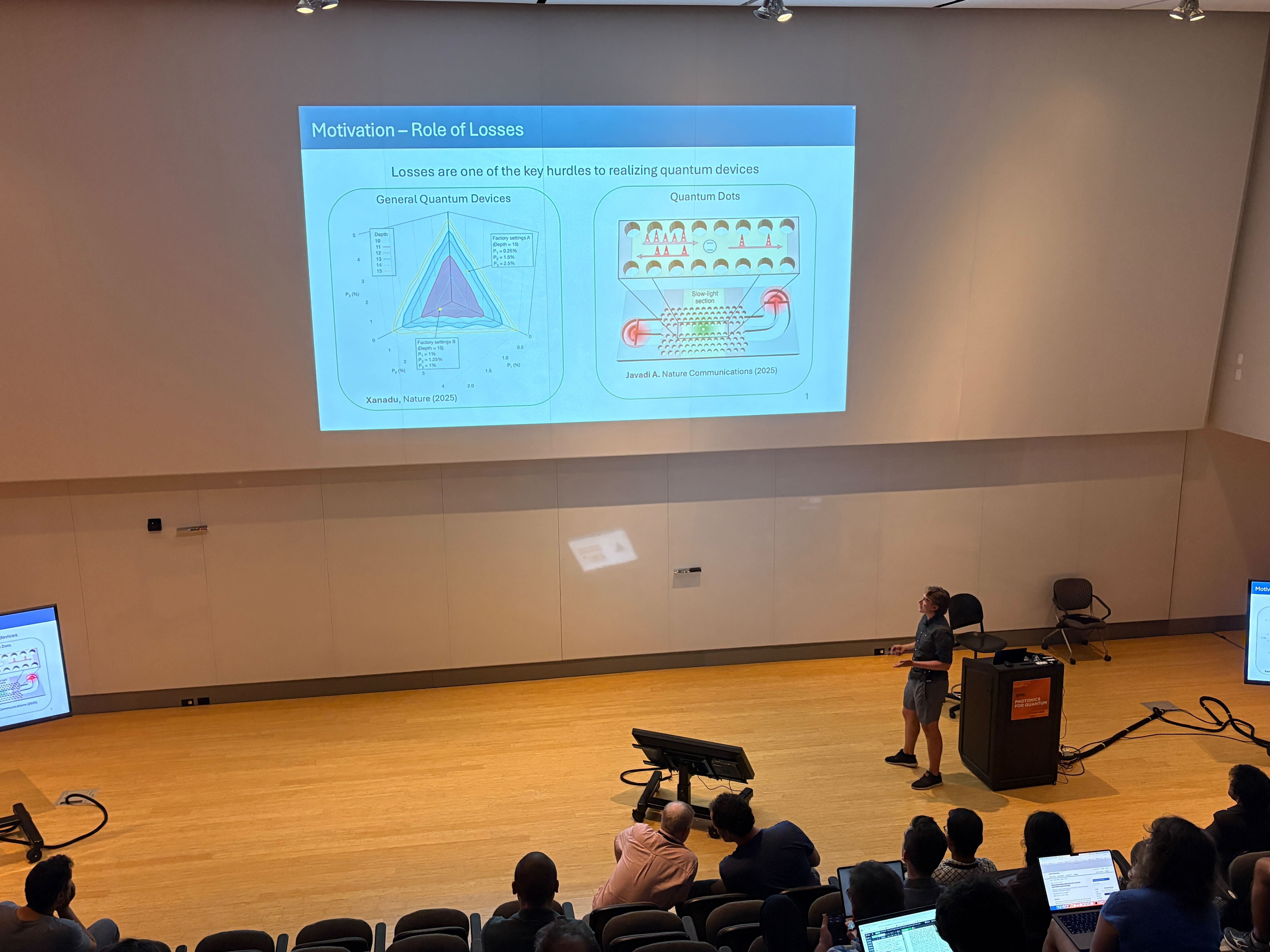
Photonics for Quantum 2025, Waterloo, Ontario

Grand Forks, British Columbia
Background
My entire life, I’ve been fascinated by the ability of physics and mathematics to explain the world. That curiosity led me to study a broad range of topics, from thermodynamics to topology and many areas in between, and ultimately to pursue a master’s degree in optics and high-performance computing. Through this work, I’ve found myself consistently drawn towards engineering and its potential to turn these ideas into technologies that move the world forward. My research has been deeply rewarding, and I’m excited to work with a team to create tangible technologies that make a meaningful impact.
Education
I graduated with a Bachelor’s in Engineering Physics with a specialization in Computing from Queen’s University in 2024. After completing my undergraduate degree, I pursued a master’s degree in optics and high-performance computing since I was interested in applying my skills to real-world problems. My research centers on the inverse design of grating couplers and photonic crystal waveguides for nonlinear quantum optics, and I currently have one published paper and another in preparation. Throughout this work, I have been particularly interested in creating designs that remain effective under realistic fabrication variations, with the goal of reducing loss and improving device yield and incorporating these devices into complete and reliable PICs. To gain a stronger understanding of industry practices, I completed the AIM Photonics PIC1 course, where I designed a full DRC-clean tapeout-ready transceiver circuit centered around a custom slow-light, reverse-biased MZM using a photonic crystal waveguide designed in my master's.